AWARE
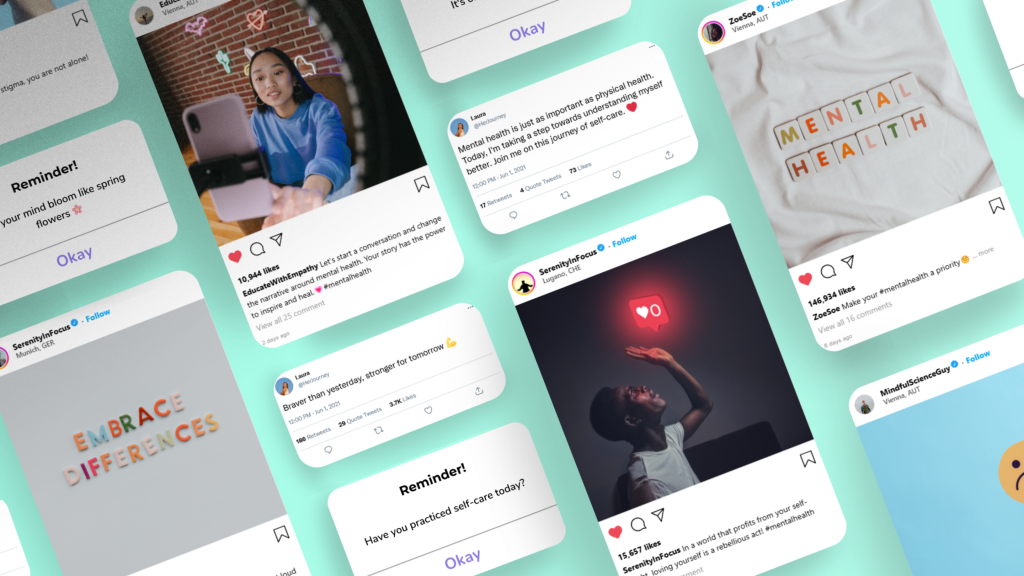
Mental health, particularly depression and anxiety, is a prevalent topic on social media. While it raises awareness and promotes help-seeking behaviors, it can also lead to overinterpretation and self-diagnosis. Social media play a crucial role in shaping beliefs, opinions, and values, especially among adolescent users. Yet, little is known about how and by whom mental illnesses like depression and anxiety are portrayed on social media and which implications the portrayal has on the perceptions, beliefs, and well-being of adolescent users.
AWARE is a three-year project with four research objectives:
- Investigating how adolescents perceive mental health, particularly depression and anxiety, in their daily lives (including social media).
- Analyzing the portrayal of depression and anxiety on social media.
- Examining the reciprocal relationships between exposure to these portrayals and adolescents’ perceptions, beliefs, and subjective well-being.
- Investigating the influence of algorithm literacy, parental mediation, and perceived peer norms on these relationships.
The project runs over 3 years from January 2025 until December 2027. It uses a mixed-methods approach, including a focus group study, a content analysis of social media posts, a validation study adapting a previously developed Social Media Algorithm Literacy Scale, and a three-wave longitudinal school survey. The research will focus on adolescents aged 12 to 19 in German-speaking Switzerland, Austria, and Germany as social media use intensifies and peaks during this life stage.
The AWARE project is co-funded by the SNF, FWF, and DFG. It will be co-coordinated by three researchers from Switzerland, Austria, and Germany. An international advisory board with experts from the UK, the USA, and Germany supports the project. The project’s results can be used to derive policy recommendations and to develop targeted prevention strategies to consolidate and improve adolescents’ (perceptions of) mental health in today’s digital societies.
Website link: https://www.aware-project.com/
Principal Investigators
Anne-Linda Camerini, USI, Switzerland
Kathrin Karsay, UVienna, Austria
Ruth Wendt, LMU, Germany
Postdoctoral Researcher
Sophie Mayen, USI, Switzerland
PhD Students
Dora Weubel, USI, Switzerland
Alina Fiona Danilkow, UVienna, Austria
Hannah Bauer, LMU, Germany
Student Assistants
Janina Hagner, LMU, Germany
Andre Foster, LMU, Germany
Lena Klampfer, UVienna, Austria
-
Publications and Presentations AWARE
Presentations
Camerini, A.-L., Bauer, H., Danilkow, A., Mayen, S., Weubel, R., Wendt, R., & Karsay, K. (2026, September). From Social Media Feeds to Real-World Beliefs: Intentional and Incidental Mental Illness Exposure and Adolescents’ Prevalence Estimates. 11th European Communication (ECREA) Conference, 8-11 September, Brno, Czech Republic [invited presentation as part of a panel].
Bauer, H., Mayen, S., Camerini, A.-L., Karsay, K. & Wendt, R. (2026, September). Adolescents’ self-diagnosis of mental illness in algorithmic social media environments: A cross-sectional study on predictors and protective factors. 11th European Communication (ECREA) Conference, 8-11 September, Brno, Czech Republic.
Weubel, D., Mayen, S., Karsay, K., Wendt, R., & Camerini, A.-L. (2026, July). From Feeds to Beliefs: Adolescent Mental Illness Stigma Profiles and the Role of Social Media Exposure. International Conference on Social Media & Society. 13-15 July, Glasgow, UK.
Weubel, D., Bauer, H., Karsay, K., Wendt, R., & Camerini, A.-L. (2026, June). “This didn’t exist back then”: A Focus Group Study on Adolescents’ Perceptions of Mental Illness in the Context of Family, Peers, School, and Social Media. 76th Annual International Communication Association (ICA) Conference. 4-8 June, Cape Town, South Africa.
Bauer, H., Mayen, S., Camerini, A.-L., Karsay, K. & Wendt, R. (2026, June). Self-Diagnosis of Mental Illness in Adolescence: A Cross-Sectional Study on Predictors and Protective Factors in the Context of Algorithmically Curated Social Media Content. 76th Annual International Communication Association (ICA) Conference. 4-8 June, Cape Town, South Africa [research escalator presentation].
Danilkow, A., Mayen, S., Camerini, A.-L., Wendt, R., & Karsay, K. (2026, June). “Depressed or Just Monday?” - A Content Analysis of Concept Creep in Public TikTok Posts about Mental Health, 76th Annual International Communication Association (ICA) Conference. 4-8 June, Cape Town, South Africa.
Bauer, H., Mayen, S., Camerini, A.-L., Karsay, K. & Wendt, R. (2026, March). Selbstdiagnosen psychischer Erkrankungen im Jugendalter: Eine Querschnittstudie zu Prädiktoren und Schutzfaktoren im Kontext algorithmisch kuratierter Inhalte in sozialen Medien. 13th Congress of the Society for Empirical Educational Research (GEBF), 16-18 March, Munich, Germany [invited presentation as part of a panel].
Bauer, H., Wendt, R., Weubel, D., Karsay, K., & Camerini, A.-L. (2025, September). How Adolescents Perceive and Evaluate Algorithmically Curated Mental Illness Content on Social Media: A Focus Group Study. Annual conference of the German Health Communication and Science Communication Division (DGPuK). 10-12 September, Munich, Germany [poster presentation].
Danilkow, A., Mayen, S., Camerini, A.-L., Wendt, R., & Karsay, K. (2025, September). Depressed, or Just Monday? A Content Analysis of Concept Creep in Social Media’s Mental Health and Well-Being Discourse. Annual conference of the German Health Communication and Science Communication Division (DGPuK). 10-12 September, Munich, Germany.
Weubel, D., Bauer, H., Danilkow, A., Karsay, K., Wendt, R., & Camerini, A.-L. (2025, September). Mental health perceptions among adolescents in the context of family, peers, and social media. Swiss Public Health Conference, 10-11 September, Lugano, Switzerland.