
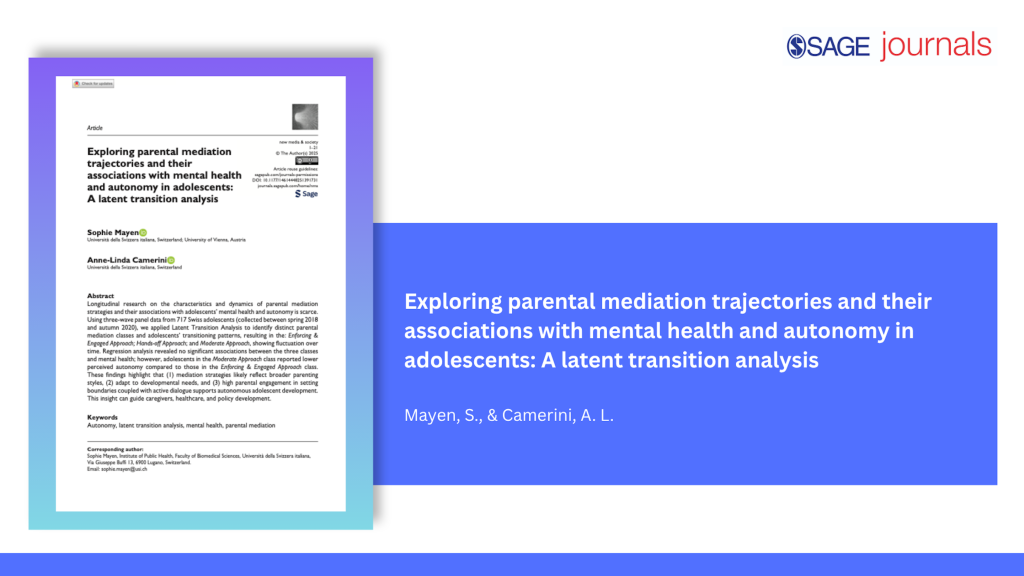
+++Publication Alert+++ Exploring parental mediation trajectories and their associations with mental health and autonomy in adolescents: A latent transition analysis
MEDIATICINO
1 September 2025
Longitudinal research on the characteristics and dynamics of parental mediation strategies and their associations with adolescents’ mental health and autonomy is scarce. Using three-wave panel data from 717 Swiss adolescents (collected between spring 2018 and autumn 2020), we applied Latent Transition Analysis to identify distinct parental mediation classes and adolescents’ transitioning patterns, resulting in the: Enforcing & Engaged Approach; Hands-off Approach; and Moderate Approach, showing fluctuation over time. Regression analysis revealed no significant associations between the three classes and mental health; however, adolescents in the Moderate Approach class reported lower perceived autonomy compared to those in the Enforcing & Engaged Approach class. These findings highlight that (1) mediation strategies likely reflect broader parenting styles, (2) adapt to developmental needs, and (3) high parental engagement in setting boundaries coupled with active dialogue supports autonomous adolescent development. This insight can guide caregivers, healthcare, and policy development.